I needed to find a new place to live. But apartment hunting is challenging when you are totally blind. To help me develop a plan of action, I contacted a social worker at a local community center.
Her first question was, “Are you looking for assisted living?” I was momentarily confused because I had said only that I was looking for an apartment.
But I quickly realized why she had asked. She saw a man in his mid-sixties who was blind and living on his own. In my experience, people often believe that blindness and older age together are so disabling that caretaking is necessary.
Before I had any noticeable sight loss, people treated me as a fully capable and responsible adult. When my sight loss became obvious, people sometimes asked, “Who takes care of you?”
Because most people rarely encounter someone who is blind, their views on blindness and disability most likely come not from direct observations, but from cultural stereotypes learned during their socialization.
Attack of the Stereotypes
Beginning in early childhood, we learn from others the importance of distinguishing people by social categories, such as gender, age, and race (Augoustinos & Walker, 1998; Farago et al., 2019). Each category includes a relatively small number of characteristics that we glean from a variety of cultural sources such as movies, cartoons, teachers, family members, and so on. For example, the older blind cartoon character, Mr. Magoo, was a favorite of mine in my childhood. He bumbled his way through life while narrowly and unknowingly avoiding serious injury or death.

Mr. Magoo unknowingly cutting his tie as if it were food.
Source: Mr. Magoo / UPA
From such cultural sources, we construct social stereotypes. A social stereotype is a set of characteristics thought to be typical of members of a social group (Devine, 1989; Judd & Park, 1993; Locksley et al., 1982). For example, if you ask people to describe adults who are blind, they often list characteristics such as incompetent, dependent, helpless, isolated, uneducated, and unemployed (Heaslip, 2024; McDonnall & Antonelli, 2018; Nario-Redmond, 2020).
And if you ask them to describe older adults, they often list characteristics such as frail, worthless, miserable, senile, disagreeable, isolated, and depressed (Fraser et al., 2016; Richeson & Shelton, 2006).
Once a social stereotype is established in memory, it is activated whenever one encounters a group member (Devine, 1989; Nario-Redmond, 2020). The activation of a stereotype triggers corresponding thoughts, emotions, and behaviors. Thus, given the primarily negative set of characteristics in the stereotypes for older and blind adults, people most likely will respond negatively to individuals from these groups.
In childhood, when initially learning these stereotypes, people do not have the cognitive ability to critically evaluate their accuracy (Devine, 1989). Later in adolescence and adulthood, people may decide that a social stereotype does not reflect reality. They may try to replace the flawed stereotype with personal beliefs that better reflect the variability and complexity of individual group members.
But rejected social stereotypes do not disappear. They were learned early in life and have become embedded in a large network of associations in memory (Devine, 1989; Nario-Redmond, 2020). Any object or situation that is even loosely associated with a rejected stereotype can activate it unconsciously.
For example, the stereotype for blindness might be activated by guide dogs, canes, a movie with a blind character, etc. A memory that has been activated frequently in the past will be retrieved with little or no mental effort, and may affect thoughts, emotions, and behaviors unconsciously and involuntarily (Bargh, 1994; Bargh & Williams, 2006). In essence, stereotype activation becomes a “mental habit.”
Stereotype activation triggers unconscious mental processes that direct attention and guide the interpretation of events (Bargh, 1994; Bargh & Chartrand, 1999). For example, when I take a walk, my gray hair, white cane, and sunglasses activate the older and blind adult stereotypes in people driving by. Sometimes, they stop and ask me if I am lost. They interpret the situation, not as “a man taking a walk,” but as “a man who cannot see how to get home.” Then, the stereotypic belief that I am helpless compels them to offer their help.
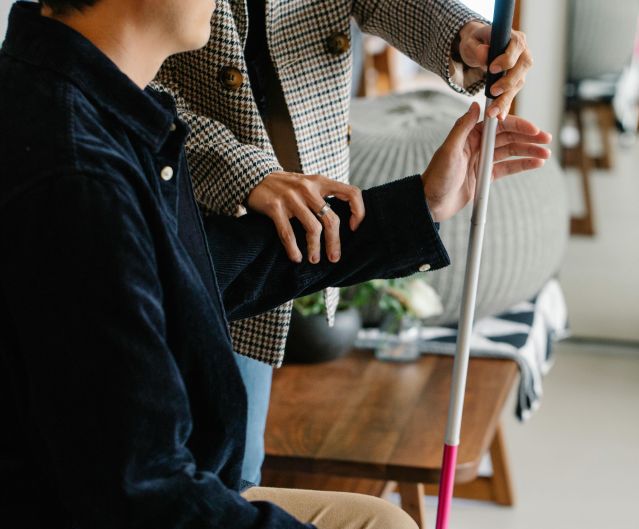
A blind man being helped by a sighted person.
Source: Eren Li / Pexels
Is Helping Always Helpful?
People offering help may feel good about their concern for others. But what effect does the offer of help have on someone who did not want or need help? And are some ways of offering help more appropriate than others? These are important questions to which I will return in future posts. Here, I will briefly discuss some harmful effects of “patronizing help.”
People offering patronizing help express a sense of superiority over those they are helping (Nario-Redmond, 2020). Patronizing help often is targeted at groups stereotyped as incompetent and dependent, such as blind and older adults, who often are treated as if they were children (Crawford, 2015; Richeson & Shelton, 2006; Shaw & Gordon, 2021).
It is not uncommon for healthcare professionals working in long-term care and assisted living facilities to talk to clients in a type of “baby talk” known as “elderspeak.” Elderspeak is a form of communication characterized by:
- exaggerated speech modulation and intonation (e.g., sing-song voice)
- use of diminutives and terms of endearment (e.g., “young man” and “sweetie”)
- use of simpler words and shorter sentences
- use of collective pronouns (i.e., “us” and “we”)
Researchers have found repeatedly that using elderspeak while helping high-functioning older adults is psychologically harmful to them (see review by Richeson & Shelton, 2006). These adults experienced feelings of humiliation, lowered self-esteem, increased dependency, and a sense that they are less able to communicate effectively.
Helping, as I will discuss in future posts, is not always helpful. It is least likely to be helpful when it is motivated by the activation of negative stereotypes than by the actual desires and needs of the people being helped.