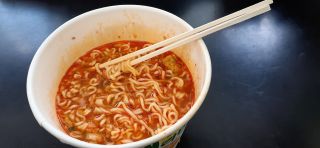
Source: 지식피그/licensed under the Creative Commons Attribution-Share Alike 4.0 International license
Korean Air recently announced that it will no longer serve hot-cup noodles on its routes, citing safety concerns. The level of outrage that followed, including in my circle of friends, was quite palpable: How dare they?
Now, I realize that in the grand scheme of things, the elimination of cup ramen on airplane rides is something that even the strongest lover of ramen noodles will be able to overcome. Eventually. I think.
But this blow-up over ramen got me thinking about my own “How dare they?” (or a more tempered “I need to think more about this”) moments, specifically in connection to big and small changes that I observe in Korean culture.
This requires a bit of an explanation about me. As a Korean American who regularly visits and spends time in South Korea for both personal and professional reasons, I am constantly struck by the rapid changes in the country. Some of the changes I can quickly recognize and then move on (e.g., the closure of my favorite donut shop in the Mapo district of Seoul), whereas other changes linger in their psychological impact.
Here are some examples of what I mean. Some of these are trivial, like the Korean Air and ramen example; others are deeper and more consequential. Those of you who are Korean American (or other Americans with clear memories of your culture of origin), you might be able to relate to some of these.
- There was a time when Korean restaurants did not charge for extra rice and kimchi. Now, it is common practice to add to your bill if you ask for one more rice bowl.
- There was a time when taxi drivers were much more lenient with squeezing in extra passengers (Four people in the three-seater? Why not?). These days? Not a chance.
- The practice of giving up one’s seat on the bus for an older person seems not as commonplace. Eyes glued to smartphone screens, and ears plugged with air pods, it’s easier to ignore the elderly who might benefit from a seat.
- I recently visited Olive Young (a popular beauty product store in Seoul) at my daughter’s request to purchase something for her. Given my limited understanding of teen beauty products, I decided to ask a worker for assistance. This worker was super helpful in listening to my inadequate explanation of what my daughter had conveyed to me, and eventually explained to me that the store no longer carries the product. Only after I stepped out of the store did it dawn on me that this Olive Young worker had communicated to me the entire time in fluent English. To be clear, it was not their English skills that were surprising. Instead, it was the way both of us eased into this English conversation – both of us visibly Korean, or at least of East Asian background – in an aisle of a bustling store located in the heart of Seoul.
- The other day, I was watching a Korean music show, and one of the artists featured was a girl group made up of entirely non-Koreans— but all singing in Korean. K-pop used to mean Koreans singing and dancing; that’s no longer the case.
As you read my examples, you might be attributing my responses to the stubbornness or inflexibility of older generations — an “out of touch” understanding of how the modern world and its people operate. There is even a Korean phrase to critique this phenomenon: 나 때는 말이야 (nattaeneun mariya1; translated to “back in the day”). And this phrase is shortened to “나때” (nattae) and sometimes even cleverly transformed into “라떼” (same sound as the word for “latte”) to mock older folks who insist on telling stories about their glory days — or at least, how things were better in the past.
So, I will accept it, without defensiveness, if you accuse me of engaging in “라떼” behavior by presenting the list above.
But do you know what else the “back in my day” conversations might really be about?
I think it’s grief.
It’s grief, not because the changes and shifts I listed above as examples are inherently bad or inferior: In fact, many of the changes are for the better, some indisputably so. And it is not because there is some kind of interpersonal loss involved, as we are generally inclined to think about grieving.
No, this type of grieving is not primarily about mourning. Nor is it focused on an interpersonal loss. Rather, it is a process of first recognizing that some things are not the way they used to be. It is a realization that what I embraced as reality is no longer so; what I held as “truth” is now forever etched in the fabric of the past. Accompanying this recognition is the awareness of why the change is occurring or has occurred, and that (often) the change is for the better.
Let me return to my example about K-pop. As a Korean American, I have always scratched and clawed to claim a part of Korea as my own. Of course, not as much as a Korean Korean in being able to say “mine,” but at least more so than my non-Korean foreigner counterparts. Put differently: I took some solace in the fact that K-pop singers resembled me more than they resembled my non-Korean counterparts. This is why, when the definition of K-pop and its represented artists expanded to include non-Koreans, even while recognizing this as a positive—Korean is no longer the homogenous country it once was—there is this other complicated emotion of grieving the shift. Again, not because globalization is bad, but because there is a recognition of an irreversible change that requires acceptance on my part.
So, sometimes I grieve, and grieve intentionally, when I encounter changes in Korea that are discrepant from my understanding and experiences as a Korean American. I direct compassion toward myself for the perspectives I had internalized—my experiences, which are valid, shaped my perspectives—but I also attempt to see the positives underlying the change(s). And doing so allows me to continue to appreciate the complicated, beautiful, ever-changing country that is Korea and the people who are connected to it.
Romanization of Korean words in this post was accomplished using this Korean Romanization Converter.